El movimiento es la mejor medicina

El movimiento es la mejor medicina
Mostrando entradas con la etiqueta Educación. Mostrar todas las entradas

Selección de recursos para estudiar francés


Salut mes amis!


     En las últimas semanas he vuelto a retomar el estudio del francés para preparar mi siguiente aventura. Y como toda persona que quiere retomar un idioma después de cierto tiempo, me encontre con las tradicionales dudas:


"¿Por donde empiezo?, ¿tengo suficiente tiempo para dedicarle?, ¿Cojo mis antiguos libros de texto?, ¿me pongo a hacer examenes-tipo?, ¿como se decia bienvenidos amigos mios?..."

Después de varios dias de investigación, he conseguido encontrar varios recursos muy útiles para el estudio de este hermoso y útil idioma. Los comparto por si pueden ayudar a cualquier persona qui a été, est ou sera en mi misma situación.

   *RFI - Journal en français facile: Emisión de 10 minutos de duración sobre las noticias más relevantes del dia. Con un lenguaje y vocabulario adaptado (que no especialmente sencillo), se trata de una gran herramienta para trabajar la escucha a la vez que se escuchan las noticas más relevantes de los paises francófonos.
  Link: http://savoirs.rfi.fr/fr/apprendre-enseigner/langue-francaise/journal-en-francais-facile

   *Coffee break - French: Curso gratuito de idiomas en el que las sesiones se estructuran en podcasts de 15-20 minutos de duración. A partir de una situación dada (un email, una conversación...) se practica la escucha y posteriormente se analiza el lenguaje, las expresiones útiles y puntos de gramática.   Hay distintos niveles estructurados en temporadas (1, 2, 3 y 4). El inglés se utiliza como lengua de apoyo.
   Link: https://radiolingua.com/coffeebreakfrench/

   * FILM FRA - Peliculas en francés con subtitulos en francés: Para ver en streaming o para descargar. Un método indispensable para aprender cualquier idioma.
    Link: http://www.filmfra.com/

   *  TV5 Monde - Titulares del teledario en 3 minutos:  Cadena televisión francesa en la que se pueden ver un breve resumen de las noticias. Hablan a una velocidad muy acelerada, pero el recurso de las imagenes facilitan mucho la comprensión. En su pagina web principal, la sección FLASH:
  Link: http://www.tv5monde.com/

  * France bienvenue - Videos de conversaciones cotidianas con las transcripciones: Estupendo sitio web con videos de temáticas muy distintas en el que escucharás a personas francesas comunicandose como en el dia a dia.
 Link: https://francebienvenue1.wordpress.com/

------------------------------------

      Libros de texto para prácticar los aspectos más formales de la lengua:

 -  Gramatica: Descargar aqui.

 - Conjugaciones verbales: Descargar aqui.

 - Trabajar las 4 habilidades (comprensión oral/escrita y expresión oral/escrita) con ejercicios progresivos: Descargar aqui.
     
     Y unicamente nos quedaría por intentar ampliar nuestro vocabulario, y para ello lo mejor es... libros, libros y libros!

     - http://ebook-gratuit-francais.com/ : Multitud de libros para descargar en formato epub y pdf

     - http://www.litteratureaudio.com/   :  Audio-libros en francés para ir escuchando en el movil, en el coche, en el mp3...

------------------------------------

Para terminar, decir que estos recursos son perfectos para aquellas personas con un nivel intermedio en frances (b1-b2), para aquellos que se encuentren empezando o ya en un nivel avanzado recomiendo lo siguiente:

 - Nivel básico: Para empezar con el idioma o "volver a calentar" después de mucho tiempo, recomiendo las APP MÓVILES gratuitas que podemos encontrar. En mi opinión las mejores son DUOLINGO y MEMRISE.

-   Nivel avanzado:  "BREF" - Una miniserie cómica con capitulos de 2 minutos en el que se narran el dia a dia de un treinteañero francés.   VER EL PRIMER CAPITULO AQUÍ


 Estos son los recursos que personalmente he encontrado más útiles, pero seguro que hay muchísimos más y en constante desarrollo.... Ya no hay escusa para no aprender un idioma nueva gracias a internet.
   ¿Y tú, tienes algún método que te haya funcionado especialmente bien?


Traditional & Popular Games - Sweden: Kubb, Varpa & Pärk


Let´s start this catalog about tradicional & popular games from all around the world with three games from the Viking Age that are still played in Gotland Island (Sweden). They are called  Kubb,  Varpa, and Pärk. 

  • Name: KUBB
  • History and origin:  

It is a modern version of an old and widespread European lawn game, but anyway the origins of the game are not clear.  It comes from the Viking age, although the modern version was created in the Island of Gotland in the late 1980´s.   
In Europe and the US, where kubb is a really popular sports with a big variety of championships and tournaments, today is often marketed as "Viking Chess", or as an “Old Norse Viking outdoor game”.  
In Wikipedia it is described as “a combination of bowling, horseshoes, and chess.”  

  •  Participants:  Two teams.  From 2 players to any even number of players. Preferably less than 12 players with one kubb set. (to promote the participation) 
  • Equipment:   Twenty-three game pieces. Ten Kubbs, rectangular wooden blocks 15 cm tall and 7 cm square on the end. One King, a larger wooden piece 30 cm tall and 9 cm square on the end, sometimes adorned with a crown design on the top. Six Batons, 30 cm long and 4.4 cm in diameter. Four Field Marking Pins, to designate the corners of the pitch and two to mark the centerline. 
  • Rules:
   "To determine which team throws first, one member of each team throws one baton while attempting to land it closest to the king kubb without knocking it over. Assume for demonstration purposes that Team 1 was the closest. The game starts with Team 1 throwing four batons from behind the baseline at the base kubbs of Team 2. Tosses are underhand only and the kubb must tumble end over end and not side to side. 

   After all four batons have been thrown, Team 2 picks up the toppled base kubbs and tosses them so they land on Team 1’s half of the field. Team 1 stands up the kubbs, now called field kubbs, where they landed. Team 2 then attempts to knock over the field kubbs using six batons; only in the first round are participants limited to four batons. If successful in knocking down all field kubbs, Team 2 may then attempt to knock over Team 1’s base kubbs with any remaining batons. Team 1 picks up any toppled kubbs and likewise tosses them to Team 2’s side. However, if Team 2 in the previous round was unable to topple all of the field kubbs, Team 1 now has the advantage of being able to throw from the nearest upright field kubb instead of the baseline. 

   The game continues until one team has toppled all of the field and base kubbs of the other team. At this point, the leading team attempts to knock over the king kubb to then win the game. If either team prematurely knocks over the king kubb, the game is over." Matthew Cummiskey (2013).  
  • School adaptation:    Although one Kubb´s full set costs around 220 SEK (25€), school often cannot afford to pay for this type of equipment. Therefore, making with the students our own Kubb set can be a funny and interesting activity in class.  This way, ours pupils will learn to cooperate as a group to make something, at the same time that they realized about how easy it is to make any kind of sports implement (balls, racquets, Frisbees,...) with cheap and recyclable materials. 

 - About the rules,  we can modify them to teach our pupils a bigger variety of body skills and learning:  Only throw with the no-dominant hand,  make the playing field bigger or smaller, use heavier or lighter materials to make the pieces, etc. 


----------------------------------------------------------------------------------------------------------------

  • Name:  VARPA  
  • History and Origin: 

Varpa is an old outdoor game. The game dates back to the Viking Age and survived in Gotland together with several other medieval or Viking games.  
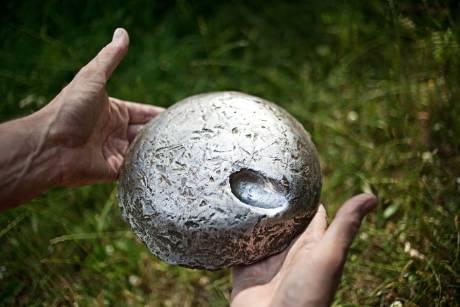
The game can be described as a version of boles but played with a flat and heavy thrower known as "varpa" instead of balls. These used to be well-shaped stones, but nowadays aluminium is more popular. Varpa is an old word which simply means "to throw". 
By excavations on the isle of Gotland finds have been made quite clearly indicating that since centuries varpa must have been thrown there. 

The official competition rules by the Swedish Varpa Association do allow the use of stone varpas for certain exclusive competitions, and there are still great competitions of this sort especially on the Isle of Gotland. Stone varpa is a particularly proper game as a family and exercise sport, maybe especially because of the fact that it can be practised so quite easily. You will only need two sticks and foe each competitor a comparatively flat stone, and you can then have a go on any reasonably even grassy place, lawn or what have you. 

Varpa thrown in several countries but probably reached its greatest international audience in 1972 when it was exhibition sport at the Paralympics in Heidelberg, West Germany. 
  • Participants:  You can compete individually or in teams consisting of two or three competitors and also as mixed competition. 
  •  Equipment:  Two sticks or cones to mark the place from players should throw, and to mark the "goal". We also need the "varpas", stones or something heavy with any type of shape except rounded . 
  • Rules:  There are two different forms of competitions, and they are known as centimetre varpa and "bumping" varpa. 

The most popular form of varpa is bumping varpa. The competitor to get his varpa in the position closest to the goal stick "is keeping the position" to his team, and his team mates are not to throw, until a member of the opposing team either has "taken" the position or "killed" it or equalized it. The competitor whose varpa after a completed round is in a position closest to the goal stick has gained one point, and he is then to start ("lay on") the next round (throwing in the opposite direction). The competitor or the team first to reach a total of 12 points has won the set. In a full game you normally ought to win 2 sets out of 3. 

  • School adaptation:  The main adaptation for this game is related to the "varpas" that our students are going to throw. They shouldn´t be heavy due to security. So we can think about how to make them with alternative and reclycable materials. For example to get the half-rounded shape, we can use a funnel full of rice or sand and cover it with plastic tape. 


----------------------------------------------------------------------------------------------
  • Name: PÄRK
  • History and Origin:  Pärk  is like an ancient kind of tennis game, played outdoors.  Like most of Swedish traditional games, it is still played in the island of Gotland. They are part of what has become called "Gutniska Lekar", and are performed preferably on the Midsummer's Eve celebration on the island, but also throughout the summer months.   
  • Participants: Two teams of 7 players each one. A park man, two kasmötare, two halvdreivar and two langdreivar.  
  •  Equipment: One ball (traditionally made of a tight ball of yarn that has been dressed in sheepskin), and cones to limit the field.
  • Rules:

The field is 30 metres wide and can vary in length. The players hit the ball with their hands or kick it.  The Pärk (which is a box made of wooden slats)  itself works as serve ground. It is marked off with wooden laths and measures 2.1 X 0.7 metres. 

The game starts by one player serving with an underhand stroke the ball in the park, and the team's Park man returns the ball to the other field.  You get a point ("Take the land") by getting the ball to bounce twice or roll on the team's area. First to 40 points wins the park (the set). Best of 3 Parks wins the match.  

  • School adaptation:   Like in any other sports game, we can modify the field to increase or decrease the difficulty. Of course also the ball´s size and weight can be replaced depending on the age and physical condition of our pupils.   

Traditional & Popular Games: Introduction to the catalog

    As future physical education teacher, I have found that traditional games put together the perfect combination of culture and physical activity. 

     Therefore in this "catalog", I will humbly try to expose some interesting traditional games, that can be applied to physical activity lessons in order to teach the pupils about traditional culture at the same time that they improve their body learning and skills.


    Two are the main objectives of this work. First of all, collect and compare an unknown, but fundamental part of a nation´s culture and folklore such as traditional games. Our ancestors used to play many different forms of games when there were festivities, something to celebrate or just when they had a break from hours and hours of work. Those typical displays are a great source of knowledge to know our history and how we have been developing and evolving until nowadays. Therefore, by researching on the topic, we will be able to compare and know more about the similarities and differences among the countries.


     Secondly, I will try to show how useful can be traditional games applied to any kind of educational center. As future teachers, we will find that these games are an excellent tool to achieve an integral and comprehensive development on our students. At the same moment that they are working on their body learning, they can as also being taught in other areas of knowledge such as history of their ancestors or geography of the areas where the games were played. Personally, I also think that physical education, and specially traditional games, is a great opportunity to study ecological awareness. Consequently and being aware of the lack of money that many centers suffer nowadays, I will try to show another way of build the needed equipment with alternative and cheap materials. Although the traditional equipment will be also shown.

What are exactly traditional games?


    Moreno, Mata y Gómez (1993) define them as playful activities with an ancestral and local perspective, that came from previous generations, and have a cultural nature from an anthropological
perspective. However, there is a huge terminological discussion about the adjectives and terms to describe and define this kind of games. Therefore, we will have a closer look to all the different acceptations used to talk about them.

Popular games: Meaning they are played by the general population, without any
distinction of age, sex or social class. They are part of the popular culture.

Native/autochthonous games: Referenced to their origin from a specific country or place.

    However, it would be possible to find a native game, but no traditional because it could have disappeared or has been modified by cultural evolution. Also, we could find a popular game without a specific origin. Finally, it would be possible a traditional game, but not popular because it would be only played by minority people. Therefore, we find that "traditional games" is the best and most complete definition.

    There are also other less popular acceptations to describe and talk about them such as rural games, yard games, or lawn games.

Why are these games so important and useful as an educational tool?

    As future teachers or workers in the world of the physical activity, it is mandatory that we know about and use a really important phenomenon of human nature as it is the game. We can consider the game as a useful and playful tool to develop our students physically and cognitively, at the same time that they have fun. 

    Another important consideration has to do with the situation of traditional games nowadays. Since the efforts of professionals and institutions are nonexistent, we can consider these small pieces of ancient culture as almost forgotten elements persistent only in the memories of our elders.It is our own responsibility trying to make them endure for the future generations. For what there are basically two ways of achieving it.

    First, propose traditional games as elements that enrich our understanding of our culture. So in moments of celebration or festivities, they could be a tourist resort and promotion added to many places that continue to keep alive all these activities.Secondly, by trying to institutionalize or formalize them. Creating federations, regulations of the games, and periodically championships, these traditional games will continue being played. 

    Traditional games are also a great opportunity for learning things about the history of people.By comparing different games, we can learn and understand better the differences of our cultures, contributing to cultural enrichment of collective heritage.

     However, the greatest contribution from a recreational perspective is the freedom that they propose. A breathing space in a society in which we are limited by numerous worries, professional stress, schedules, rules, prohibitions and responsibilities of our daily lives.

The Catalog

       To present the traditional games from different countries and parts of the world, I will use the following folder structure to classify them in the simplest and most efficient way.


* References

  • Méndez Giménez, A. (2003). Nuevas propuestas lúdicas para el desarrollo curricular de Educación Física. Barcelona: Paidotribo
  • Moreno, C. Mata, D. y Gómez, J. (1993). Aspectos recreativos de los juegos y deportes tradicionales en España. Madrid: Gymnos.

Sesión ELE: Niñ@s 10-12 años. Gustar/Tiempo Libre

Contexto y características del grupo
Nivel: A2/B1
Edad: 11-12 años
Nacionalidad: Portuguesa
Tipo de curso:  3 clases/semana. 1h30min lunes y miércoles. 1h viernes.  (4 horas en total)
Nº de alumnos: 6

Recursos del aula: Cañón electrónico para reproducir la pantalla de un ordenador. Altavoces. Pizarra con rotuladores.
Recursos didácticos:
- Sopa de letras con los pronombres
- Letra de la canción
(4 copias. 1 por pareja y la nuestra)

Duración de la sesión
Una sesión de una hora y media con un descanso de 10 minutos (80 minutos reales de clase).

Objetivos de la sesión
●       Hablar de gustos e intereses de la clase en el tiempo libre

Contenidos
●       Funcionales: expresar gustos e intereses, preguntar por gustos e intereses.
●       Gramaticales: verbo gustar
●       Léxicos: actividades de tiempo libre
●       Socioculturales: tipo de actividades de tiempo libre.


VIDEO DE LA CANCIÓN: "Juntos de excursión"  Goofy e hijo.

https://www.youtube.com/watch?v=SJyLkhcwo0g

------------------------------------------------

Ø  INICIO DE LA SESIÓN CON LA RUTINA DIARIA
1.      Todas las clases empiezan con un saludo grupal (juntaremos las manos en un circulo y a la de UN, DOS TRES... haremos un pequeño grito al estilo  EQUIPO DEPORTIVO).  
2.      Después al llegar los alumnos al aula, siempre habrá escrito una pequeña frase en la pizarra (Podrá ser un pequeño chiste, adivinanza, refrán...) Intentarán descifrar su significado y después el profesor lo explicará.   Hoy será: ¿Quién es el hijo de mi papá y mi mamá que no sea mi hermano?
3.      Finalmente, un alumno escribirá la fecha del dia en la pizarra. 
10 MINUTOS

Ø  REPASO DE CONTENIDOS ESTUDIADOS EN SESIONES ANTERIORES:
              
Contenido: Los pronombres personales (Yo, tu, el/ella, nosotros, vosotros, ellos)

1.      Empezaremos la sesión con una pequeña sopa de letras en la que los alumnos tendrán que buscar los pronombres personales (aparecerán dos veces cada uno).  Estos no estarán escritos en ningún sitio, sino que tendrán que recordarlos de la sesión anterior.  Será un trabajo por parejas, y en caso de no recordar cuales son, el maestro podrá dar "pistas" en forma de frases o enfatizando los mismos al explicar el juego.

10 MINUTOS

2.      Una vez encontrados todos los pronombres en la sopa de letras, cada pareja tendrá que hacer una frase con cada uno de ellos. La misma podrá ser de temática libre pero tendrá que tener coherencia en el significado.

5 MINUTOS

INTRODUCCIÓN DE LOS NUEVOS CONTENIDOS:

1.      En primer lugar escucharemos y veremos el video de la canción. Para ello daremos una hoja con la letra a cada alumno.
Después de la primera escucha, haremos una preguntas de comprensión general.  ¿Cuál es el tema de la canción? ¿Qué está pasando? ¿Están contentos Goody y su Hijo?

10 MIN

2.      Después haremos una segunda escucha en la que los alumnos y nosotros mismo cantaremos.  Después se pondrán por parejas e intentarán contestar a las siguientes preguntas: ¿A vosotros os gusta ir de excursión?  ¿Qué otras cosas os gustan hacer?


10 MIN

3.      Después de dejar que los alumnos intenten pensar durante unos minutos la respuesta y distintas opciones, haremos una puesta en común.  Después el maestro añadirá distintas opciones a la lista: "Jugar al futbol, leer libros, ver la televisión, salir con mis amigos, pintar..."

5-10 MINUTOS

4.      Después se pondrán por parejas y tendrán que hablar y elegir que actividades les gusta hacer en su tiempo libre.  Mientras tanto el Maestro pondrá en la pizarra,  la conjugación del verbo gustar, como ayuda. De esta manera mientras hablan utilizarán la primera persona.

5-10 MINUTOS

TAREA FINAL DE LA SECUENCIA:

Finalmente tendrán que ponerse en pie por parejas y contar al resto de la clase, que le gusta hacer en su tiempo libre al compañero y porqué. (utilizando la tercera persona).

15 MINUTOS

--------------------------------------------------

ANEXO: LETRA CANCIÓN
Goofy:
NECESITAS UNAS VACACIONES
OLVIDAR LA PRISA Y LA TENSIÓN
SI TUS NERVIOS VAN A REVENTAR
COGE UN AMIGO Y A RODAR
Y JUNTOS MARCHAOS DE EXCURSIÓN.
 
Max:
ES MEJOR QUEDARSE CASTIGADO,
ES MEJOR COGER UNA INFECCIÓN.
CON SU CONDUCCIÓN TAN PECULIAR
QUE GANAS DA DE VOMITAR,
LAMENTO SALIR DE EXCURSIÓN.
 
Goofy:
INTENSAS EMOCIONES
QUE NUNCA OLVIDARÉ
SIGUIENDO EL MAPA JUSTO HASTA EL FINAL.
 
Max:
ROXANNE, NO ME ABANDONES
UN DÍA VOLVERÉ
PASANDO ANTES POR EL HOSPITAL
 
Goofy:                                Max:
MAX Y YO,
COMO EN LOS VIEJOS TIEMPOS            ESTO SÍ
                                      QUE ES UNA PESADILLA
COMO AMIGOS
LLENOS DE ILUSIÓN                     DESTROZAR
                                      LA DESESPERACIÓN
ESTO ME DA GANAS DE LLORAR
 
Max:
ME PASA ALGO SIMILAR
 
Goofy + Max:
SALIENDO JUNTOS DE EXCURSIÓN.
 
Conductores:
¿VAMOS BIEN PARA LLEGAR A NASHVILLE?
FÍJATE POR DÓNDE VAS, BUFÓN
NO TENGO PRISA POR LLEGAR
PUES DONDE VOY A IR A PARAR
NO CREO QUE SALGA DE EXCURSIÓN.
 
A PASAR UNA SEMANA JUNTOS,
NUESTRA GRAN ROMÁNTICA ILUSIÓN
A CALIFORNIA A DESCANSAR
QUITAD, TORTUGAS, APARTAD
Y DEJO DETRÁS AL PELOTÓN.
 
Goofy:
ESTANDO JUNTO A MAXIE
ME SIENTO MUY FELIZ.
 
Monjas:
DEMUÉSTRALE CARIÑO PATERNAL
 
Goofy + Monjas:
¡YEEHA!
 
Max:
QUE ALGUIEN LLAME UN TAXI
Y ME SAQUE DE AQUÍ
PREFIERO ESTUDIAR AUNQUE SEA UN HORROR.
 
Goofy + Conductores:
¡OH!
CADA DÍA NUEVAS AVENTURAS
CADA DÍA AUMENTA LA EMOCIÓN
DEJARÁS ATRÁS LA GRAN CIUDAD
 
Max:
ME QUEDARÍA SIN DUDAR
 
Goofy + Conductores:
PARECE UN ELIXIR
QUE BIEN ME HACE SENTIR
ES UN PLACER SALIR
JUNTOS DE EXCURSIÓN.
----------------------------------------

¿QUÉ OPINAIS? ¿OS IRÍAIS CON GOOFY Y SU HIJO DE EXCURSIÓN?

Viajes: Londres (2011)

Mi Primera Semana en el Colegio


ST. EUGENE DE MAZENOD CATHOLIC PRIMARY SCHOOL

Con una gran Iglesia pegada, el colegio dejo claras sus conocidas intenciones religiosas desde el principio (para que luego no haya sorpresas…). Una fachada de colegio clásica hizo disminuir un poco mis temores, que fueron sustituidos por una inmensa alegría cuando descubri un patio trasero con canastas y dos camas elásticas que me prometí probar si o si lo antes posible, siempre desde un interés puramente pedagógico, of course…


      A nuestra llegada nos recibió el 'headteacher assistant Mr. Donagiu'. Tour por el colegio, preguntas, horarios, bla bla y para...

YEAR 5

Teacher: Ms. Parker
Teacher Assistant: Miss Bessant
*29 niñ@s de entre 10-11 años.

Mis primeras conclusiones en cierto modo extrapoladas y adaptadas desde el mundo de la didaktika:

- Espacios:  Las clases estan completamente decoradas con murales, dibujos, fotografias, trabajos... realizados por los propios alumnos. En cierto modo se asemeja a una clase de educación infantil española.

- Metodología muy dinámica con constantes preguntas y salidas a la whiteboard. Realizan mucha menos cantidad de ejercicios, pero por el contrario los razonan mucho más y deben saber explicar como llegaron al resultado.


- Disciplina impresionante. El silencio es la regla y no la excepción. Cuando los alumnos estan hablando el profesor levanta la mano o simplemente se queda en silencio hasta que el ruido para. Mi clase, considerada la más disruptiva del colegio, sería una de las mejores en casi cualquier colegio asturiano.

- No tienen libros de textos. Los profesores tienen un gran trabajo de planificación ya que se preparan ellos mismos todas las lecciones y materiales.

- Constante y continuo sistema de refuerzo positivo. Bien sea oralmente o con diversos sistemas de premios y recompensas.

- Religión como un importante elemento dentro de la vida escolar. 3 rezos al dia (al llegar, antes de comer y al marchar). Además de 2 clases de religión, y una "misa'.


Hay muchas más cosas, pero ya intentaré ir entrando en detalles más adelante. De la educación fisica mejor ni hablar todavia....
Con la tecnología de Blogger.